




Future Development Direction Of Paper Cup Mechanical Technology: Intelligent Module And Deep Fusion Of New Material Applications
May 15, 2026
Leave a message
Driven by increasingly stringent global environmental policies and changing consumer demands, the paper cup machine industry is undergoing a profound transformation from traditional machine manufacturing to intelligent, green manufacturing. Future technological advancements will revolve around three core areas –intelligence, modularization, and new material applications – to create new industrial ecosystems characterized by data-driven, flexible production, and sustainable materials.
1.Smart: From Standalone Control to full-flow digital twins
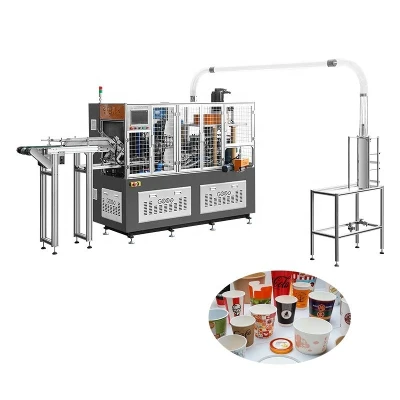
Smart has become a major driver of mechanical upgrades to paper cup. Intelligent control systems based on the industrial Internet are gradually replacing traditional PLC control, integrating sensor networks, edge computing and artificial intelligence algorithms to achieve real-time monitoring and autonomous optimization of device performance. For example, Ruian Mingyuan Machinery's MYC-180S full-servo paper cup machine, equipped with 14 servo motors and a distributed motion controller, synchronized material feeding, die-cutting positioning and robotic arm collection, achieved a production speed of 210 cups/ min with a stable size tolerance of ±0.1mm. More advanced devices employ digital twin technology that uses virtual modeling to simulate production processes, predict equipment failures and optimize process parameters, reducing unplanned downtime to less than 4 hours per month.
Artificial intelligence-driven vision inspection systems are revolutionizing quality control. The combination of high speed camera and deep learning algorithms replaced manual sampling inspections and realized real-time detection of defects such as uneven curling of cup rim and leakage of the bottom of the cup. The product yield rates increased to 99.97%. An international coffee brand has cut customer complaints by 60% and minimised raw material waste by deploying smart quality inspection equipment. Additionally, IoT technology has transformed the way devices are maintained. Remote diagnostics systems supported by 5G networks upload real-time data on energy consumption and production, while predictive maintenance features reduce fault resolution time by 80%.
2.Modular: from Fixed Functions to Flexible Manufacturing Platforms
Modular design is reshaping the product structure of paper cup machines. By decomposing equipment into separate functional modules such as material feeding, molding, bottom sealing, printing, etc., manufacturers can quickly respond to different market demands. For example, in order to meet the demand of the new tea beverage industry for heat-resistant double-walled paper cups, Mingyuan Machinery has developed an extendable double-walled molding module, adding an inner heat-resistant paper feeding system and a hot melt coating device to enable single machines to produce both single-walled and double-walled paper cups. A Brazilian customer used a onboard paper cup machine equipped with integrated solar energy and portable modules to produce 2,000 cups per day to meet temporary market and festival needs.
Rapid diechanging technology represents a major breakthrough in modular design. While traditional devices required downtime of four to five hours to switch cup sizes, modern machines with standardized interfaces and automatic parameter matching reduce mold changes to less than 180 minutes. A German enterprise's intelligent paper cup machine comes preloaded with 300 library of 300 process parameters that support one-click toggles the size of 9-22 ounces of paper cups, resulting in a 40% increase in productivity for small orders. Modular design also simplifies equipment maintenance, allowing operators to quickly resume production by replacing fault modules and reducing annual maintenance cost per machine by 30%.
3. New Material Applications: A Paradigm Shift from Petroleum-Based to Bio-Based Materials
Environmental regulations compel paper cup makers to adapt to biological materials. The EU's Single Use Plastic Directive calls for the phasingout of traditional plastic cup lids by 2025, accelerating research into alternatives to polylactic acid-coated paper and plastic-free paper. To solve PLA's thermal instability problem, Mingyuan Machinery has developed gradient heating sealing technology to control heating temperatures in stages to prevent degradation of the coating, while ensuring that the cup bottom seal meets IP67 waterproof standards. A U.S. fast food chain is using the technology to create "standable burger boxes" that are 85% recycling rate and reduce plastic use by more than 200 tonnes a year.
Plastic-free cup technology represents the pinnacle of material innovation. microplastic pollution risks is eliminated at source by special processes to improve the inherent water resistance of paper. A Japanese company's nanocoating technology creates a dense hydrophobic layer on the surface of the original paper, allowing the cup to hold 100°C of hot water without leaking, while completely degrading in natural environment in 60 days. In order to adapt to this material, paper cup machine requires an ultra-precise processing system. Mingyuan's MY-X500 color digital printer is equipped with HP printheads and Eco-friendly Ink to support high precision pattern printing on the surface of A3-sized cup surfaces to meet brand customization needs while ensuring ink components meet FDA food exposure safety standards.
4. Technological Convergence: Building a Sustainable Manufacturing Ecosystem
In the future, the development of paper cup machine will be characterized by the deep fusion of multiple technologies. Prototypes of hydrogen fuel-cell drive systems have been tested to achieve zero carbon emissions during operation, saving about $12,000 per machine per year in electricity cost savings, and are particularly suitable for remote or off-grid areas. In production process optimization, heat recovery devices recycling (recycle) sealing the waste heat of the dry material in the cyclic sealing process and reduces energy consumption by 15%. An international paper cup manufacturer has adopted the system, which reduces CO2 emissions by 120 tons per production line per year,equivalent to the environmental benefits of planting 6,000 trees.
Vertical integration throughout the supply chain is accelerating the commercialization of technology. Leading enterprises to the upstream extension, into the original paper embossing and coating processes, to achieve end-to-end control from raw materials to finished products. Mingyuan Machinery's upcoming pulp molding industrial park will produce environmentallyfriendly raw paper containing 30% bamboo fiber, 20% stronger than traditional paper cups and 40% less water consumption in the process. This vertical integration model not only enhances supply chain resilience, but also provides an application testing platforms for the development of new materials, creating an ecosystem of closed-loop innovations spanning "material-equipment-products."
Verdict: Leading the green transition through Technological Synergy
Driven by environmental regulations and market demands, the paper cup machine industry stands in a critical stage of technological transformation. The deep integration of intelligent, modular and new material applications will propel equipment manufacturers from product suppliers to holistic solutions suppliers. In the future, companies that integrate interdisciplinary technologies and rapidly adapt to market changes will gain a competitive advantage in the global green economy, delivering core equipment and building a sustainable packaging industry.
Send Inquiry