




Understanding The Process Of Paper Coffee Cup Making Machines
Oct 15, 2025
Leave a message
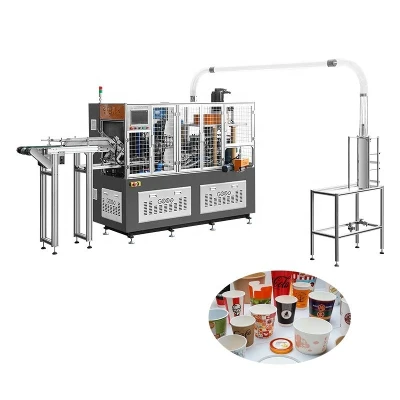
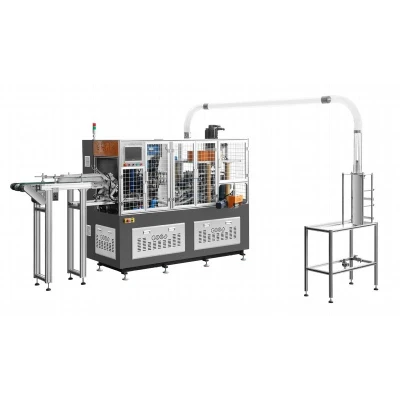
The key to understanding the process of making paper coffee cup is to master the five core automation steps from the original paper to finished cup. Each link is connected, and finally a complete production process is realized: ``raw material distribution → component molding → Assembly and sealing → → Forming and testing → finished product distribution." Here is a clear step-by-step explanation:
1.Pre-Process: raw material preparation and core materials
Before starting the machine, you must confirm the core raw material-laminated paper (kraft paper or white cardboard on the outside and PE leak prevention on the inside). It is usually rolled (for fully automatic machines) or sheet of paper (for semi-automatic machines). If trademarks are required, print paper in advance before entering the production process. ii. Complete Production Process: 5-Step Automated Processing (Take Mainstream Automated Machine as Example)
1.Step 1: Raw paper feed and cut -"Cut large rolls into Small Blanks."
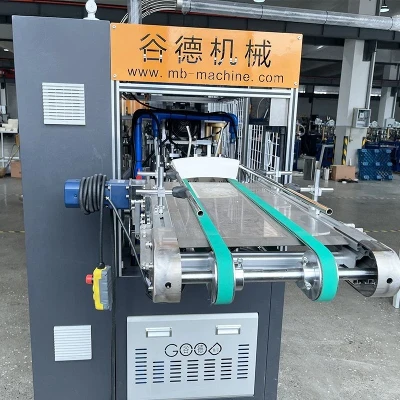
The laminated paper roll is mounted on the machine's "paper feeder" and fed into the "cutting mechanism" at a steady rate (usually in line with subsequent processing steps to prevent paper deviation) through a guide rollers and tension controller.
The cutting mechanism cuts consecutive paper roll into two types according to pre-set dimensions:
Cups rough: Usually fan-shaped or rectangular (depending on the design of the cup, it can be rolled up to form a cylinder) and the dimensions correspond to the height and circumference of the cup.
Cup base rough: They are uniformly round and slightly larger in diameter than the bottom opening of the cup, a "joining protrusion" at the edge to facilitate subsequent adhesion to the cup.
2, two kinds of rough cutting, through a separate conveyor belts to the "cup body forming station"and ``cup forming station '', to prevent mixing. Step 2: Cup Body Forming -"Transform flat paper a 3D Cylinder"
This step transforms the rough part of the cup into a sealed cylinder. Its core process is "Curl + Heat Seal":
Curl and shape: the cup body rough into the ``cup body mold"through the robotic arm. The mold's inner wall is suitable for rough, and the flat rough is rolled into a cylindrical shape (body prototype) by rotating or extrusion to ensure the cylindrical seams are consistent.
Seam heat sealing: The die contains heating element (approximately 120-180°C, matching the melting point of the PE coating). At the same time, the hot press wheel applies pressure to the seam of the cylinder, melts and adheres to the inner PE coating to form a sealed, leak-free cup.
Cutting: Sealed long cylinders are cut into individual cups with a "cutter" to match the height of the coffee cup. The rims are also initially trimmed to prevent material jamming in subsequent steps. Step 3: Shape the bottom of the cup -"press round paper into the shape of the bottom."
The rough part of the cup base needs to be machined into a a "jointable cup base"with raised edges. This process is relatively simple, but requires a high degree of precision:
High-pressure stamping: transport the billet to the ``cup base die ''. The mould uses pressure of 5-10 MPa to press flat paper into the bottom of the cup shape, with "concave centres and raised edges" (raised edges are important as they will later be embedded in the bottom).
Heating Cure: The stamped cup base is briefly heated (to the same temperature as the heat seal on the cup) to allow the PE coating to solidify and solidify. This ensures that the bottom of the cup is not easily deformed, and the raised edges are of precise size, perfect for the cup. Step 4: Assemble the cup body and base -"Add the cup body to form a complete cup body to ensure Leak-Proof."
This is a key step in determining whether the cup will leak. There are two main assembly methods:
Positioning and docking: A robotic arm turns the cup upside down on the "assembly station" while aligning the bottom with the opening at the bottom of the cup, ensuring that the pre-recorded grooves in the inside of the cup are perfectly aligned with tolerance + -0.5mm.
Seal and reinforce:
Hot Press Sealing: The assembly station's heating ring applies pressure and heat to the "bottom up" contact area, melting and bonding the PE coating between the two to form a single, integral seal (most commonly used and cost-effective).
Ultrasonic Welding: High-frequency vibrations are used in higher-end models to replace heat sources, creating frictional heat and melting PE coating in contact areas to make seals safer and not carbonize paper due to high temperatures.
Once assembled, the machine briefly maintains pressure (1-2 seconds) to ensure that the bond solidifies completely and prevents it from breaking during subsequent transport. Step 5: Ring forming, testing and finished product output -"make the cup usable and qualified"
The final step is to optimize the user experience and select eligible products:
Rim Finishing: The assembled cups are sent to the "Rim Forming Unit," where rotating blades trim the rims to create a smooth, burr-free finish. Alternatively, add Alternatively, an "inward curl" or "outer bead" (to prevent a scratch on the lip and enhance the feel).
Quality Inspection: Some machines are equipped with visual inspection system that automatically check for three key points: 1) whether the cup body is damaged or scratched; 2) whether the seams and base are sealed (no cracks); and 3) whether the edges are smooth. Unqualified products were shoved into bins.
Finished collection: Qualified coffee cups are transported to finished product bins on a conveyor belt and stacked neatly in a predetermined quantity (e.g., 50 per stack). It can then be covered or boxed directly with dust film. III. Key Supplement: Process differences between Semi-Automatic and Fully Automatic Machines
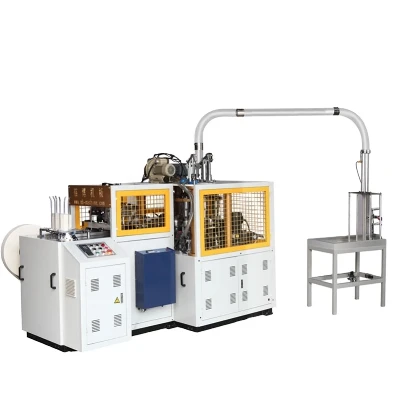
For small batch production, semi-autonomous machinery also requires manual operation:
Semi-automatic machines require manual intervention to place the cut off cup body rough into the mold. Once the base is formed, manual assistance is also required for docking and assembly. Only the heat sealing and molding steps are automated.
Less efficient than fully automated machinery (typically 60-120 pieces perminute for fully automated machinery and 20-30 pieces perminute for semi-automated machinery), suitable for small workshops or customization.
Send Inquiry